Thursday, February 20, 2014

“In the odyssey of life it’s very unlikely that one may return to the same destination from where they started their life journey” : Actor and Line Producer Sandeep Kulkarni in a freewheeling chat with writer Niilesh A Raje speaks about his upcoming socio-psychological thriller Hindi movie Dombivli Return

by: Niilesh A Raje


You are now making your debut in the Indian Film Industry as Line Producer with your upcoming socio-psychological thriller Hindi movie “Dombivli Return”. Is this movie a sequel to your acclaimed Marathi hit “Dombivli Fast” in which you had played the lead role?

Well, “Dombivli Return” is not a sequel to my 2005 Marathi movie “Dombivli Fast”. My movie is a socio-psychological thriller which speaks about a common man named "Anant Velankar" from Dombivli whose lead role has been played by me.

Anant comes from middle class Marathi family staying in chawl and is working full time as a Photographer in Mantralaya with the PR Department. The look and feel of the chawl, dressing style of this middle class man Anant coming from Marathi family has given our Hindi movie a Marathi texture. 

Anant’s wife is an excellent housewife who takes good care of the home front. They have one small kid who is going to the school. Anant’s younger brother is a Commerce Graduate and pursuing his CA.

Apart from pursuing photography as his full time job in Mantralaya Anant also works as “Freelance Photographer”. His regular friend circle includes his train friends whom he meets daily as part of his commute from Dombivli to work place and vice versa. He also has one of his friends from Dombivli who owns the photo studio locally. As this man is working in Mantralaya’s PR department his job profile gives him close access to work with Ministers.

Why Dombivli? Do you have any memories attached to this beautiful place which even I do admire?  

Well, Dombivli is a beautiful suburb in the city of Mumbai located in Thane District. Many Marathi families who were once working and staying in Girgaon post their retirement made this beautiful suburb Dombivli as their new home which predominantly had Maharashtrian population then. On personal front yes I had the opportunity to stay in Dombivli when my parents were staying there for brief period of roughly three years or so. Today, also I do visit Dombivli when we have any family function or get together.


What is the significance of the word “Return” in your movie title “Dombivli Return”?

(Smiles) Good question. The word “Return" is like when one asks for a “Return Ticket” at the ticket counter when travelling. The “Return Ticket” grants one the permission to travel to one’s chosen destination and allows you to return back again to your starting destination. But, in the odyssey of life it’s very unlikely that one may return to the same destination from where they started their life journey. A true and bitter reality of life. 

Who are the other artistes in this movie and the role they are playing?

The movie has been produced by Avdhoot Entertainment in association with Kathakaar Entertainment a Production House initiated by me. Avdhoot Entertainment has joined hands with Kathakaar Entertainment in the production of this movie. “Dombivli Return” is our first venture into Hindi. The movie is written and directed by Mahendra Teredesai who has assisted filmmaker Dr Jabbar Patel on several occasions.

The movie is produced by Mahesh Taras while I am the Line Producer for this movie. The lead role of the common man Anant in this movie is being played by me. We also have Rajeshwari Sachdev (National Film Award Winner for Best Supporting Actress) playing the role of a housewife in this movie. Amol Parashar theatre actor plays the role of my brother in this movie. The friend who owns his photo studio in Dombivli has been played by Hrishikesh Joshi. We also have Siya Patil in this movie, playing the role of women from Dombivli holding different relation with Anant. Music Direction has been done by National Film Award Winner Shailendra Barve.


What is the turning point in this movie and how does the plot unfolds in the end?

In this movie there’s one incident that takes place in the life of Anant coming from Marathi family. That one incident is like the slip between the cup and lip for him. The message the movie gives is when everything seems certain sometimes things can go wrong in the odyssey of life be it through temptation or any other reason which can disturb one’s happy home. It’s here the word “Return” from our movie title “Dombivli Return” unfolds as the story progress. Now, whether the common man Anant is lucky enough to return to the same destination from where he started his journey of life is something to be watched in this Hindi movie titled “Dombivli Return”.
      
Sandeep, many Thanks for giving your best support and prompt attention as part of our freewheeling chat over cup of tea on your forthcoming Hindi movie “Dombivli Return”. Here’s wishing you and your whole crew All the Best.

Saturday, February 15, 2014

Super Saturday - Niilesh A Raje in a freewheeling chat with Actor Producer Sandeep Kulkarni . . .


Super Saturday - Niilesh A Raje in a freewheeling chat with Actor Producer Sandeep Kulkarni . . .

Sunday, December 22, 2013

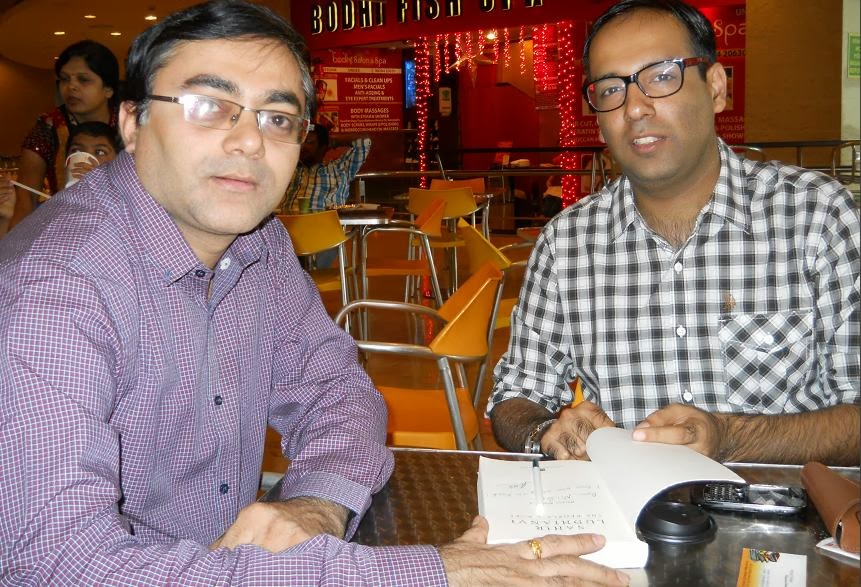
Niilesh A Raje with the author Akshay Manwani with his book Sahir Ludhianvi : The People's Poet


Sunday Morning coffee chat with the author Akshay Manwani regards his book "Sahir Ludhianvi : The People's Poet" an exhaustive biography reflecting the life and times of the renowned Urdu poet and Hindi Lyricist to be released in 2014 . . .

Sahir Ludhianvi: The People’s Poet ( Book Preview by Niilesh A Raje )


"Jo Waada Kiya Woh Nibhaana Padega"

(What has been promised ought to be honoured)

by : Niilesh A Raje


Author       
Akshay Manwani
Publisher  
HarperCollins
Pages
304
Price
Rs 399/-
ISBN
9789350297339

“Jo Waada Kiya Woh Nibhaana Padega, Roke Zamaana Chaahe Roke Khudaayee, Tumako Aana Padega” (What has been promised in the matters of the heart ought to be honoured . . . You will have to come to meet me) a lovely number from the movie “Taj Mahal” (1963 release) has been soothing the ears of the music lover’s even today post five decades of its release. This song of everlasting romance became so popular then and is even today that it fetched the renowned Urdu poet, songwriter and Hindi lyricist Sahir Ludhianvi his first Filmfare Award as the “Best Lyricist”.

The newly released book Sahir Ludhianvi: The People’s Poet by Akshay Manwani HarperCollins Publication is an exhaustive biography that traces the poet’s rich life from his troubled childhood and his equally troubled love relationships and then his rise as one of the pre-eminent personalities of the Progressive Writers Movement and as a lyricist through the golden era of Hindi film music.

Author Akshay Manwani turned to freelance writing after a brief career in the corporate world. His writings on popular Indian culture have appeared in The Caravan, Business Standard, Man's World and Mumbai Mirror. His attempt to profile the life and work of Sahir Ludhianvi stems from the belief that much needs to be done to preserve the legacy of unsung legends. It is also his way of saying thank you to the poet-lyricist who gave him immeasurable joy through his songs. Akshay lives in Mumbai with his wife and daughter.

Born on 8th March (International Women's Day) Sahir Ludhianvi captivated the hearts of several women during his life time through the power of written words. Sahir fell in love several times and always wrote poems as a tribute to his love. Sahir remained a bachelor all his life.

Sahir (meaning magician) as the name suggests he was truly a magician of words who spent over 30 years of his life associated with Bollywood, wrote over 680 songs for over 100 movies. It is said that while Sahir's heart was more concerned for others, he apparently never paid enough attention to his own life. He believed in the beauty of relations to him those who strike relations for life in his opinion were relations of a higher disposition.

The journey of this legend is covered in the book spread across 14 chapters. One of the chapter’s in this book talks about an often repeated phrase spoken by Sahir Ludhianvi. While any discussions took place between Sahir and Hameed Akhtar directing towards Sahir’s future these words were most heard off, “Bada Songwriter Banoonga” (I will become a prominent songwriter). Sahir’s aplomb in these words were more attributed to his belief in his songwriting skills rather than keeping it restricted to just his dream.

An interesting anecdote is seen in one of the chapters which speaks of “New Peaks, New Associations”. Sahir was known for his exalted ego and when his popularity was at its peak came his temperamental attitude which started rubbing people the wrong way witnessing his relations collapse with industry stalwarts like S. D. Burman as is also seen happening with many in real life for keeping their bloated ego.

Once a film maker said in presence of Sahir and Lata Mangeshkar, Sahib saab, agar Lata ki awaaz na ho toh aapke geet bejaan hai!” From that point onwards Sahir insisted that Lata would not sing any of his songs while taking up a film. On one hand no one could afford to ignore Lata Mangeshkar while on the other hand no one could even disregard Sahir.

After reading the various defining moments in the life and times of Sahir Ludhianvi in this book one thing is evident that in spite of coming out of the woods of the broken heart Sahir never lingered with one issue for long. Having given the poetic form to the particular episode in his life he felt he had fulfilled his objective. Experience enriched his life so much that Sahir’s poetry was always filled with emotions reflecting his experiences or romantic associations. The chapter “Finding Love in the Shadow of Oedipus” speaks of this.

The author has made detailed efforts to cover the “List of Film Songs”, “Select Bibliography” and “Index of Poems and Film Songs”.

The biography is indeed motivating and sets the reader’s thinking that in spite of so much mental turmoil and bitter experiences in his personal life it did not make Sahir a bitter person. Rather, it transformed his mind to look beyond his personal life. His phrases were simple but always left a profound impact on the minds of the readers. To sum it up in his own words, “Jo mil gaya usi ko muqaddar samajh liya, Jo kho gaya main usko bhulaata chala gaya, Main zindagi ka saath nibhata chala gaya”.

Saturday, September 28, 2013

Niilesh A Raje chats with Ramesh Deo


Chat with Ramesh Deo over lunch . . . 

Niilesh A Raje with actor Ramesh Deo


Chat over lunch with actor Ramesh Deo . . .

Niilesh A Raje on 107.8 FM Coverage


With the wonderful and dear RJ on command . . .Thank you to 107.8 FM for their support for my upcoming program "Dil Dhoondtha Hai . . ." an audio visual programme on the living legend Gulzar on Saturday 5th October 2013 at Ravindra Natya Mandir 8 PM